What is the UN Convention on the Human Rights of Older Persons?
the stakes behind a new un convention
A UN Convention is a legally binding international treaty that obliges governments to respect, protect and fulfil specific human rights.
A dedicated UN Convention on the Rights of Older Persons would establish clear and enforceable standards requiring states to prohibit age discrimination in law and practice, promote the dignity, autonomy, and participation of older persons, and ensure their meaningful inclusion in decision-making processes.
01. What is a UN Convention and why does it matter?
A UN Convention is a legally binding treaty that sets out rules and standards for protecting human rights. A Convention on older persons’ rights will close protection gaps by obliging states worldwide to take concrete measures.
- BLUEPRINT FOR CHANGE: It can define in concrete terms the policy changes, the kinds of support and enabling conditions that are necessary to create an equal society for people of all ages and to ensure respect for our rights throughout our lives.
- ACCOUNTABILITY: It can surface and condemn the discrimination and abuses experienced in old age and trigger measures and services to monitor, evaluate and respond to such discrimination.
- PARTICIPATION & REMEDY: It can empower older persons as rights holders and their representative organisations to claim their rights, to be fully involved in the public debate and hold governments accountable.
- VISIBILITY & TRANSFORMATION: It can challenge all the attitudes, practices and structures that drive rights violations in old age, address the systemic neglect of older people and ensure a sustained focus.
02. What is the historical context behind this decision?
Although human rights are universal, numerous reports and studies show that older persons around the world are disadvantaged in many areas.
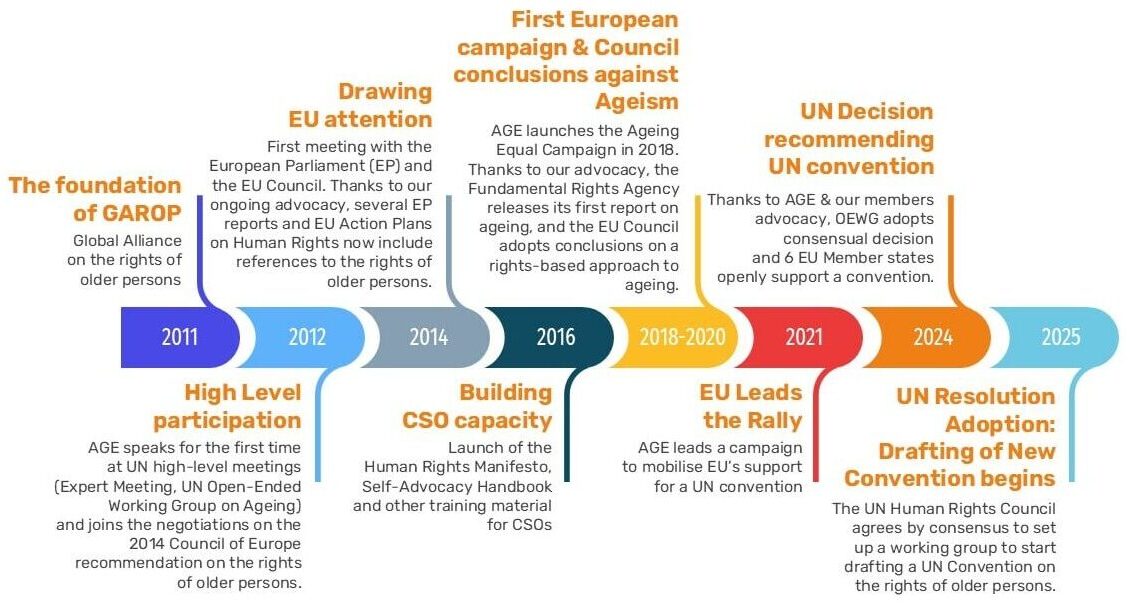
Since 2010, AGE and other civil society organisations have been active in a working group on ageing, established by the UN General Assembly. Hundreds of documents submitted to the Open-ended Working Group have shown that older people are often excluded from human rights protections, facing ageism, unequal access to healthcare, social security, and affordable housing, as well as greater risks in times of crisis.
In April 2025, the UN Human Rights Council adopted by consensus a resolution to establish an Intergovernmental Working Group (IGWG) to draft a UN convention on the human rights of older persons.
03. What are the next steps?
The first organisational session was held in February 2026. It elected its Chair and discussed modalities of participation. You can read AGE key messages for this organisational session.
The Intergovernmental Working Group (IGWG) drafting the UN Convention on the rights of older people is expected to meet twice a year in Geneva, in five-day hybrid sessions. The first two meetings for 2026 were confirmed and delve into the content of the UN Convention.
- 13-17th July 2026 – first session
- Find out what happened during this first substantive session.
- Before the session, a call for inputs was issued to inform discussions on the general framework, architecture, and guiding principles of a legally binding instrument on the human rights of older persons.
You can read AGE response to the call for input here. - All submissions, including AGE’s, can be found online here.
- AGE also contributed to the consensus position of the Global Alliance for the Rights of Older People (GAROP).
- 26-30th October 2026 – second session
- Find out what happened during this second substantive session.
- Five key elements of the future Convention were examined: the preamble, definitions, general principles and State obligations, the catalogue of rights, and the monitoring mechanism. AGE presented oral statements for each segments.
- AGE also contributed to the discussions papers of the Global Alliance for the Rights of Older People (GAROP).
- 2027 – third and fourth sessions
- The third and fourth sessions of the intergovernmental working group are tentatively scheduled to be held from 19 to 23 July 2027 and from 1 to 5 November 2027 respectively.
- Information about the programme of work of previous and following sessions are available on the Intergovernmental Working Group website.
Find out how to participate in the next sessions here.
04. FAQ (Frequently Asked Questions)
Drafting and adopting a UN Convention is a complex multi-year process.
The IGWG will meet twice a year for five days in Geneva. This will set the pace for the negotiations, but the work also involves other elements, such as calls for contributions.
To facilitate discussions over the coming years, a timeline was agreed during the first IGWG meeting, held from 13 to 17 July 2026.
The objective of a draft zero of the Convention has been set for November 2027. The elements informing this draft include: a call for input (November 2026), regional contributions (from August to September 2027), and the designation of facilitators to submit the draft to the Chair.
Once the draft zero has been submitted to the chair, a new round of negotiations will begin.
Ultimately, progress will depend on resources, political will, and the level of international support.
UN human rights conventions are legally binding on the countries that ratify them. They:
- Provide a clear set of standards and rights;
- Require governments to align their laws and policies accordingly;
- Enable monitoring and accountability through reporting and expert review;
- Provide a basis for civil society advocacy and litigation.
In our self-advocacy handbook, we have explained in more detail how UN conventions work and provided examples of their impact. In this report we explain the added value of a new UN convention.
Conventions like the CRPD (on the rights of persons with disabilities) and CEDAW (on women’s rights) have had a transformative impact in shaping domestic legislation, funding, and awareness. For example:
- In Austria, the CRPD was used to challenge discriminatory guardianship laws, resulting in a legal reform in 2018 that strengthened autonomy and supported decision-making for people with disabilities.
- The EU itself is a party to the CRPD. This has required EU institutions to assess how their legislation and funding align with disability rights and also to adopt new legislation, such as the European Accessibility Act. It also inspired the EU’s Strategy for the Rights of Persons with Disabilities 2021–2030, showing how conventions can shape EU-wide frameworks.
- In Ireland, CEDAW recommendations were used by civil society and the government to justify major changes to domestic violence laws and to advance gender equality in budgeting and public life.
- In France, the CRPD influenced reforms on accessibility in transport and public buildings, and prompted case law on the right to inclusive education.
- In Spain, the Constitutional Court has used the CRPD to interpret anti-discrimination rights and promote inclusive education.
- The European Court of Human Rights and national courts have referred to CEDAW in interpreting anti-discrimination and equal treatment laws.
Whereas in the past EU Member States have expressed divergent positions, no EU Member State opposed this resolution. A total of 81 UN Member States co-sponsored the resolution, showing the highest level of support, among which 14 EU countries, including:
1. Austria 2. Bulgaria 3. Croatia 4. Cyprus 5. Czechia 6. Italy 7. Ireland
8. Luxembourg 9. Malta 10. Poland 11. Portugal 12. Slovakia 13. Slovenia 14. Spain
In addition, Finland supported the convention during the informal negotiations, and Belgium included the convention in its government agreement. As a result, the majority of EU Member States are active supporters of the convention. Moreover, most EU accession countries co-sponsored the resolution, including Albania, Montenegro, North Macedonia, Moldova, Ukraine, and Serbia. Turkey and Bosnia and Herzegovina had already supported the convention in previous OEWG and HRC sessions.
The resolution recognises the importance of regional efforts and calls for regional meetings to contribute to the drafting work. Moreover, the working group is expected to draw on regional experiences and standards.
Our engagement with the UN complements our EU actions. Building bridges between the international and regional levels ensures that EU values and standards inform the convention, while aligning EU policy frameworks more closely with evolving international standards.
A UN Convention can act as a catalyst for more coherent and rights-based approach to ageing also at EU level, especially if the EU ratifies the future convention.
The United Nations Human Rights Council (HRC) is the UN’s main intergovernmental body responsible for promoting and protecting human rights worldwide. Its resolutions are formal texts adopted by its member states that reflect the Council’s position on specific human rights issues. Although HRC resolutions are not legally binding, they carry significant political weight. They can initiate new processes, influence international standards, and mobilise UN agencies, states, and civil society actors.
In 2025, the HRC agrees to set a working group to start working on a UN Convention on the rights of older persons.

Contribute to the drafting process of the UN Convention and register for the next session:
Recent Updates

2nd IGWG Session: AGE and its members continue to shape the Future UN Convention
The 2nd session of the Working Group took place from 26 to 30 October to continue drafting the UN Convention on the Rights of Older Persons.

The European Parliament discusses the UN Convention for the first time
The European Parliament held their first debate on the process towards a UN Convention on the Human Rights of Older People.
International Day of Older Persons 2026: Drafting the UN Convention on the Human Rights of Older Persons
On 1 October 2026, we are renewing our commitment to the upcoming UN Convention and to advancing equality at all ages around the world.

Negotiations on a UN Convention on the Rights of Older Persons begin in Geneva
Discover the key highlights from our Members’ delegation to Geneva.
Contact