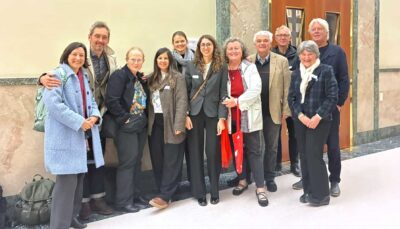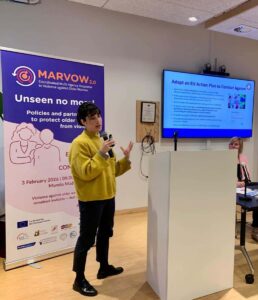
On 3 February 2026, AGE Platform Europe organised the “Unseen no more: Policies and Partnerships to Protect Older Women from Violence” conference in the context of the MARVOW 2.0 project. The policy conference brought together policymakers, practitioners, and civil society organisations in Brussels. The event marked a significant milestone in Europe’s efforts to address a long‑neglected issue: gender‑based violence against older women.
A Call to Recognise the Invisible
Opening the conference, Alessandra Pauncz (WWP EN) and Lisa Collste (European Commission) underscored the urgent need to make older women visible in policy and practice. Both speakers shared powerful testimonies of older survivors whose decades of abuse went unnoticed or unsupported, illustrating how ageism and sexism combine to silence victims. Their message was clear: violence does not end with age, and support systems must evolve to meet the needs of older women.
MARVOW 2.0: Building a Coordinated Multi-Agency Response
Martina Knoll (Association of Autonomous Women’s Shelters in Austria) presented the achievements of MARVOW 2.0, a three‑year EU‑funded initiative uniting nine partners across seven countries. With nearly 30% of the EU population projected to be older persons by 2050, the project highlights the pressing need for age‑ and gender‑sensitive responses.
Key project outcomes include:
- A Risk Assessment Checklist tailored to age‑specific indicators of violence
- A comprehensive training programme delivered to over 400 professionals
- A multi‑agency Manual of Operation supporting coordinated, victim‑centred interventions
Apolline Parel (AGE Platform Europe), presented the Marvow 2.0 policy recommendations urging for the inclusion of older women in data collection, applying an intersectional perspective and the adoption of an EU Action Plan to Combat Ageism to strengthen a human-rights based approach.
Policy Perspectives: Strengthening Europe’s Framework
Despite progress, political resistance and persistent stereotypes continue to hinder implementation. The panel called for stronger enforcement, dedicated funding, and training for professionals across health, justice, and social care sectors.
Civil Society Voices: Intersectionality at the Centre
- Violence in institutional and care settings
- The invisibility of older LGBTIQ women
- The lack of specialised perpetrator programmes
- Barriers linked to disability, mental health, and lifelong discrimination
Speakers urged the EU to improve data collection for women aged 75+ and ensure meaningful involvement of civil society in policy design.
From Risk to Response: Tools for Professionals
Lessons from Practice: Bulgaria, Italy, Spain
- In Bulgaria, local cooperation has been strengthened and violence against older women gained significant media attention.
- In Italy, Marvow 2.0 results will be integrated into the Roman anti-violence network including specific provisions for older women.
- In Spain, multi‑agency collaboration was improved through the inclusion of public services for older people and Barcelona’s 2025–2030 gender-based violence plan specifically mentions older people.
A Shared Commitment
Closing the event, moderator Alessandra Pauncz called on EU Institutions and Member States to invest in tailored prevention, specialised services, and sustainable multi‑agency systems. She emphasised that MARVOW 2.0 provides concrete tools to drive lasting change and that older women must no longer remain unseen.